
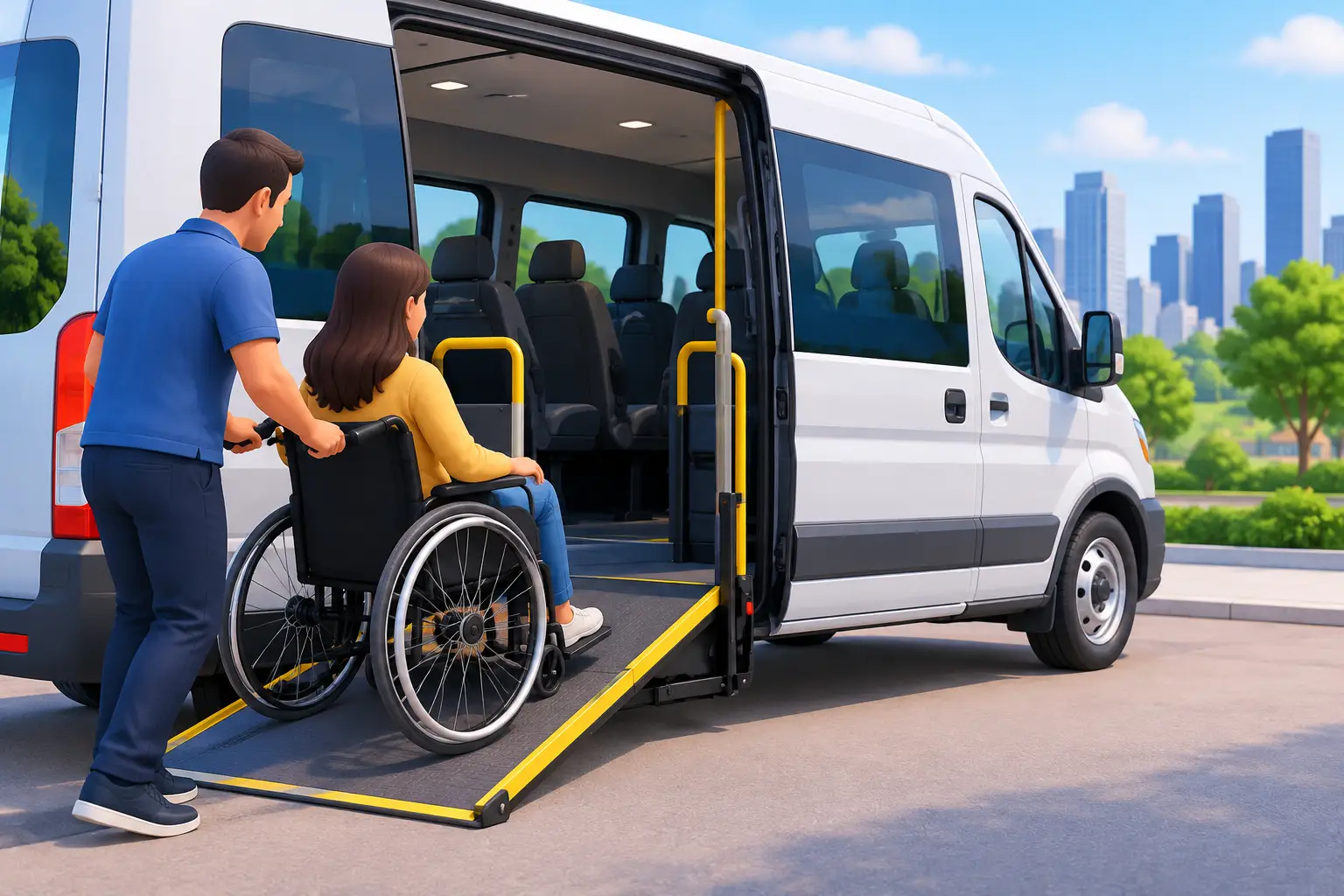
A minibus may look like the right answer for a family day out, an airport run or a hospital appointment - but do minibuses carry wheelchairs? Some do, and some do not. The difference matters because a standard passenger minibus is not automatically equipped to carry someone safely while they remain in their wheelchair.
For a journey to feel comfortable from the moment the vehicle arrives, accessibility needs to be discussed before it is booked. A properly equipped wheelchair-accessible minibus can allow a passenger to stay in their own chair, travel with companions and receive door-to-door help without the worry of an unsuitable vehicle turning up.
Do minibuses carry wheelchairs safely?
A wheelchair-accessible minibus is fitted with the equipment and space needed to take a wheelchair user safely. This is usually a rear or side ramp, although some vehicles use a lift, together with a designated wheelchair position and secure restraint system.
The passenger should not simply be wheeled into an empty space and left there. The wheelchair must be secured to the vehicle floor, and the passenger should have an appropriate seatbelt or occupant restraint. This helps keep both the chair and its occupant stable during braking, corners and changes in road surface.
Not every wheelchair-accessible vehicle is identical. Some carry one wheelchair and several seated passengers; others have a different layout and fewer passenger seats once a wheelchair space is in use. The right arrangement depends on the size of the group, the wheelchair itself and the type of journey being made.
That is why it is worth treating accessible transport as a conversation, not a tick-box. A local provider that knows the vehicle and plans the trip can make sure the practical details are handled before travel day.
What makes a minibus suitable for a wheelchair user?
The ramp or lift is only part of the picture. A suitable vehicle also needs enough internal room for safe manoeuvring and a secure position that matches the chair being carried. A manual wheelchair may be straightforward to accommodate, while a larger powered wheelchair or mobility scooter can require more space and may be heavier than expected.
When booking, say whether the passenger will travel in the wheelchair or can transfer into a passenger seat. If they can transfer comfortably, the chair may sometimes be folded and stored, but nobody should feel pressured to do so. For many people, remaining in their chair is the most comfortable, dignified and practical option.
It also helps to mention headrests, specialist seating, oxygen equipment, a high back, a reclining function or any item attached to the chair. These details are not a nuisance. They allow the driver and transport provider to prepare properly and select a vehicle that works for the person travelling.
Wheelchair size and weight matter
There is no single answer to whether every chair will fit. Ramps have weight limits, door openings vary and powered chairs can be considerably larger than standard manual models. Give the make and model where possible, or provide the chair's width, length, height and weight.
This is particularly useful if the wheelchair has a tilt-in-space function, elevated leg rests or a battery pack. A few minutes spent checking can prevent an awkward situation at collection time and means the journey can begin calmly.
Space for family, friends and luggage
Accessible travel should not mean travelling alone unless that is what the passenger wants. Ask how many companions can travel alongside the wheelchair user, particularly for airport transfers and longer days out. Luggage, walking aids and medical bags also take space, so they should be included in the plan.
A minibus can be an excellent choice for a group because it keeps everyone together. However, the exact passenger capacity may reduce when the wheelchair position is occupied. Clear information at the booking stage allows the vehicle layout to be matched to the group rather than leaving anyone to arrange a separate car.
Questions to ask before booking accessible minibus transport
A good transport provider will welcome sensible questions and answer them plainly. Start by asking whether the vehicle is specifically wheelchair accessible and whether the passenger can remain in their chair during the journey.
You should also check how the wheelchair will be secured, whether there is a passenger restraint, and whether the driver is experienced in using the ramp and tie-down equipment. These are basic safety points, not extras.
For a longer journey, ask about comfort along the way. Is there room to reposition safely before departure? Can the driver help with bags? Is a comfort stop possible if needed? For an early flight or an evening collection, confirm the exact pick-up time and what will happen if plans change.
If travelling to a venue, restaurant, hospital or holiday destination, think beyond the vehicle itself. The drop-off point may have a steep entrance, limited parking or a long walk from the door. Let the driver know about any access requirements in advance so that the closest practical and safe set-down point can be used.
Why pre-booking makes accessible journeys easier
A wheelchair-accessible minibus cannot be assumed to be available at short notice. Pre-booking gives time to confirm the chair dimensions, passenger numbers, route, luggage and any support needed at either end of the trip.
It also removes the uncertainty of relying on an anonymous vehicle allocation. A booking should result in the right vehicle arriving, with a driver who understands that time, patience and respectful assistance are part of the service. For appointments, train connections and airport travel, punctuality is especially valuable: there is enough to think about without wondering whether the transport will be suitable.
At Bright Star Travel, accessible minibus journeys are planned around the person travelling, with a ramp-equipped vehicle that allows wheelchair users to remain in their chair. That means practical arrangements can be discussed beforehand, from travelling companions and luggage to the best collection point at home.
Door-to-door support has real value
For some passengers, the most difficult part of a journey is not the miles on the road. It is getting safely from the front door to the vehicle, managing bags, navigating a busy airport forecourt or finding the right entrance at the destination.
A caring driver can allow extra time for boarding, make sure the ramp is used safely and help with luggage within the agreed arrangements. That calmer approach is particularly welcome for older passengers, people travelling after treatment and families supporting a relative with limited mobility.
When a wheelchair minibus may not be the best option
A minibus is often ideal, but it depends on the journey. If only one passenger is travelling with minimal luggage, a wheelchair-accessible car might be more suitable. Conversely, a large powered chair, several relatives and holiday cases may call for a more spacious vehicle or a particular seating configuration.
There can also be access limits at the collection or destination address. Narrow drives, low branches, tight car parks and steep kerbs can affect where a larger vehicle can safely stop. Sharing this information in advance helps the driver plan a sensible alternative rather than leaving the passenger exposed to an unnecessary walk.
The aim is not simply to get a wheelchair into a vehicle. It is to make the whole journey feel considered, safe and comfortable. When you tell your transport provider what you need, you give them the chance to get you there with care, every time.