
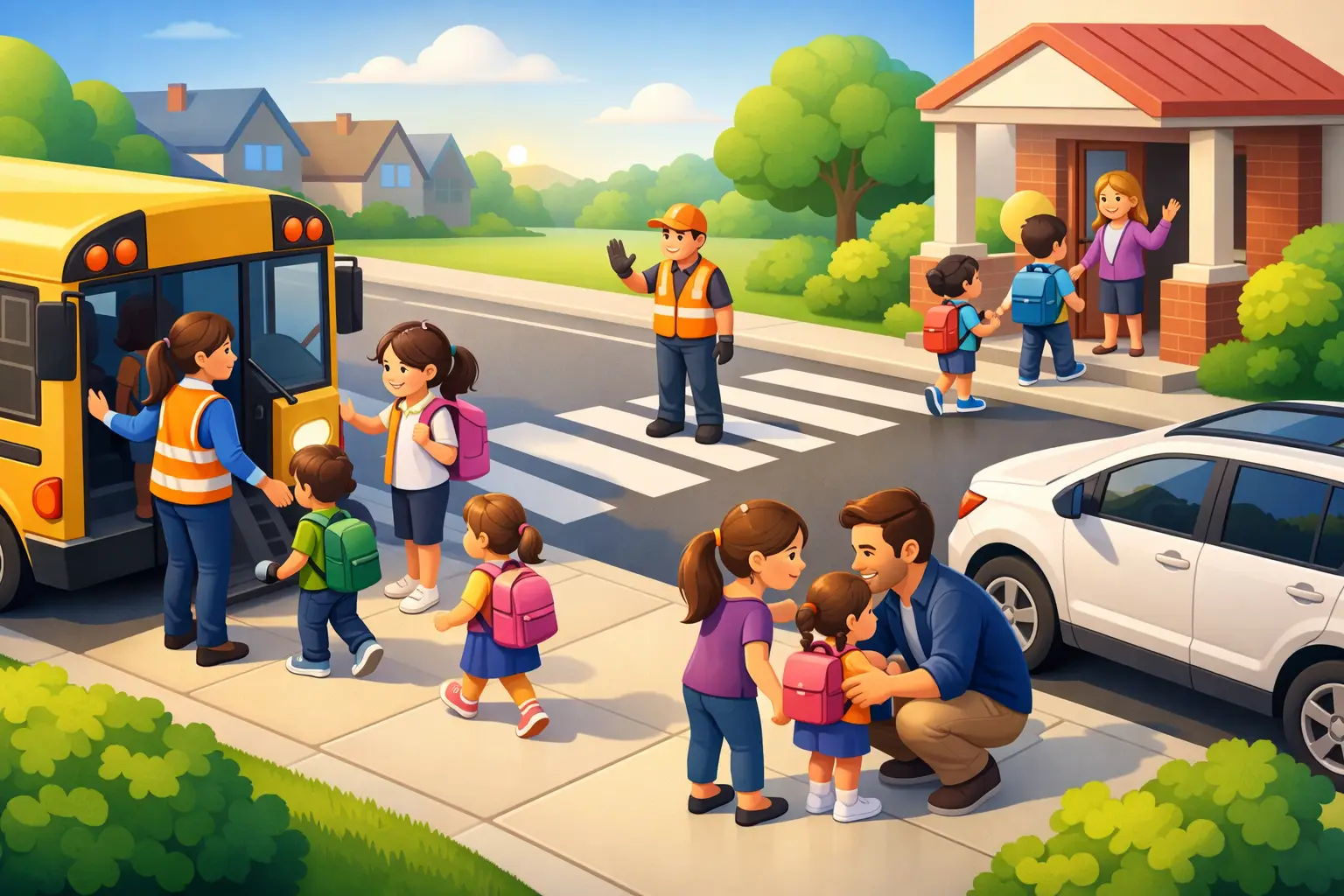
The school gates can be one of the busiest places in the day. Cars are pulling in, children are finding friends, parents are juggling work calls and bags, and staff are preparing for lessons. Good school run supervision brings calm to those busy moments by making sure every child is collected, transported and handed over with care.
For families, the value is simple: your child should never feel like a name on a list or a passenger in a rush. Whether transport is needed every day, for a temporary arrangement or as part of a school contract, clear routines and trusted people make all the difference.
What school run supervision should mean
School transport is about far more than getting from A to B on time. A properly supervised school run has a clear plan for who is travelling, where they are being picked up, who is responsible at each stage and what happens if something changes.
For younger children especially, the journey begins before the vehicle moves. They need to know where to wait, who their driver is and what to do when they arrive at school. At the end of the day, they need the same certainty in reverse: a familiar collection point, a safe vehicle and an agreed handover to a parent, carer or authorised adult.
That consistency helps children feel settled. It also gives parents confidence that they are not relying on a last-minute lift, an unfamiliar driver or a faceless taxi app when the morning is already busy enough.
The handover matters as much as the journey
The most important moments of school run supervision are often the shortest ones. A child should not be left waiting alone at the kerb because a parent is delayed, nor should they be dropped off without a clear understanding of who is receiving them.
A dependable arrangement sets out collection and drop-off instructions from the beginning. This might mean collecting a child from their front door, meeting them at an agreed safe point, or following the school’s own arrival procedure. The right choice depends on the child’s age, confidence and the layout around the school.
For some families, a doorstep collection is the most reassuring option. For others, particularly older pupils, a nearby agreed point may be practical. What should not change is the care taken over that handover. Drivers need to know the arrangement, parents need to know who to contact, and children need to understand the routine.
If plans change, communication is essential. A parent running late, an after-school club, a different authorised collector or a school closure can all affect the journey. These details should be confirmed rather than assumed. A quick conversation before the day starts can prevent a worrying situation later on.
Familiar faces build confidence
Children notice when things are predictable. The same driver, the same vehicle and the same collection routine can turn an anxious journey into an ordinary part of the day. That matters for new starters, children who find change difficult and parents managing a demanding work schedule.
A local, pre-booked transport provider has an advantage here. The relationship can develop over time. Drivers become familiar with the route, the school’s approach to arrivals and collections, and the individual needs of the passengers they carry.
This does not mean ignoring professional boundaries. It means being attentive. A professional driver notices if a child seems unsure, checks that seatbelts are fastened, keeps the vehicle calm and clean, and follows the agreed instructions rather than making assumptions.
At Bright Star Travel, that personal approach is central to regular school transport. Families and organisations need to know who is behind the wheel, how the journey is arranged and that punctuality is treated as a promise, not a hopeful estimate.
Safe routines for parents and schools
The strongest school run arrangements are shared arrangements. Parents, schools, transport providers and children all have a part to play. The aim is not to create unnecessary rules, but to make expectations clear before they are needed.
Parents can help by keeping contact details current and notifying the transport provider early about any changes. If another adult may be collecting a child, that should be agreed in advance. Children should know that they must wait in the agreed place and should not leave with anyone else without permission.
Schools can support safe arrival and collection by providing clear access instructions and making providers aware of relevant procedures. Congested gates, one-way systems, restricted parking and different collection areas for different year groups can all affect timing. A driver who knows the routine is better placed to arrive safely and without adding to the pressure outside the gates.
Transport providers should keep accurate passenger and journey details, allow sensible time for the route and communicate promptly if traffic, weather or an unexpected delay affects collection. Punctuality matters, but safe driving matters more. Leaving a little margin in the schedule is usually wiser than trying to recover time through a rushed journey.
When a child has additional travel needs
There is no one-size-fits-all approach to school run supervision. Some children may need wheelchair-accessible transport, extra time to board, a quieter journey or more reassurance when routines change. Others may have mobility needs that make a standard car or minibus unsuitable.
The best arrangement starts with an honest conversation. Families should be able to explain what helps their child travel comfortably and with dignity. That could include using a ramp-equipped vehicle, remaining in their wheelchair during the journey where appropriate, allowing extra time at collection, or following a particular handover routine.
It is also worth being realistic about capacity and support. A transport provider can offer safe, accessible travel and thoughtful assistance, but specialist medical care or one-to-one educational support may require a separate plan with the school or local authority. Being clear about responsibilities protects everyone, especially the child.
Questions worth asking before booking
Before choosing school transport, it is sensible to ask how collection and drop-off are managed, who will be driving and what happens if there is a delay or a change to the usual plan. Ask whether the vehicle is suitable for the child’s needs, whether regular journeys can be booked at a fixed time and how you can contact the provider directly.
It is also helpful to discuss timings properly. A school run should allow children to arrive without a last-minute dash, while avoiding an unnecessarily early start. The ideal route may change during roadworks, bad weather or busy periods, so a provider should be prepared to review it rather than treating the plan as fixed forever.
Price matters to families too. Clear, fixed pricing for an agreed regular journey makes budgeting easier and avoids uncertainty at the end of the week. However, the cheapest option is not always the one that offers the clearest supervision, the most dependable communication or the best fit for a child’s needs.
A calmer start and finish to the day
A well-managed school run gives children a steady beginning to the day and a safe way home afterwards. It gives parents breathing room to get to work, care for other family members or simply know that the arrangements are in hand.
The best school run supervision is rarely flashy. It is the driver arriving when expected, the child knowing exactly what to do, the seatbelt checked, the route taken safely and the handover handled properly. Those small, dependable moments are what turn a daily journey into a routine families can rely on.